differential equations linear algebra pdf
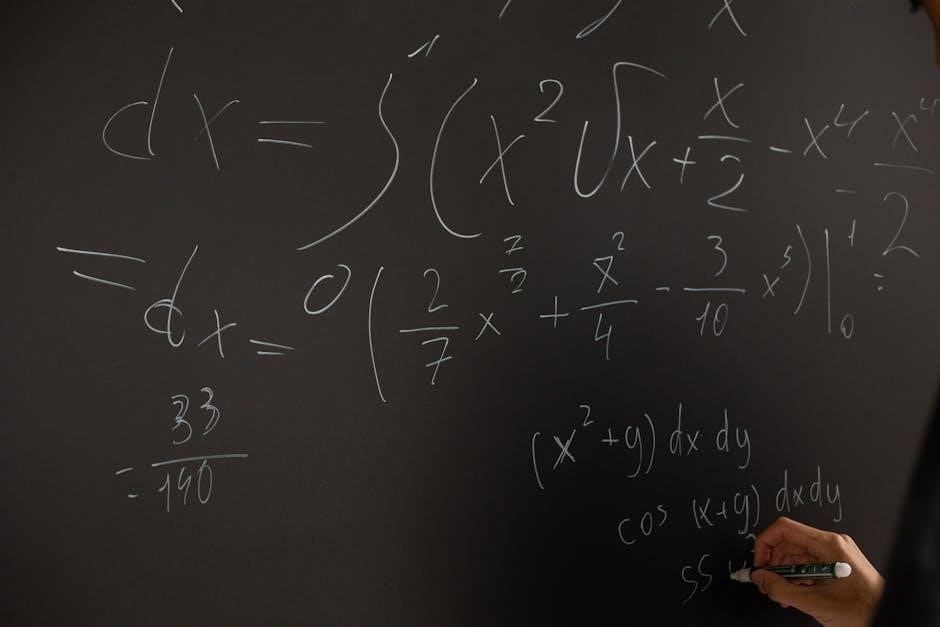
Differential Equations and Linear Algebra: A Comprehensive Overview
This course integrates core concepts from both disciplines, offering a robust foundation for engineering students,
leveraging resources like open-edition textbooks and detailed chapter outlines –
including first-order equations and linear algebra arithmetic.
The synergy between differential equations and linear algebra is fundamental in modern applied mathematics. Systems of differential equations are often elegantly represented and solved using matrix methods, a cornerstone of linear algebra. This combined approach is particularly crucial in engineering disciplines, where modeling dynamic systems necessitates understanding both rate of change and linear relationships.
Resources like the “Differential Equations with Linear Algebra” textbook by Ben Woodruff, and the combined course structure requested by engineering schools, highlight this interconnectedness. The ability to represent equations as vectors and matrices unlocks powerful solution techniques, including eigenvalue analysis and the Laplace transform.
Foundations of Linear Algebra for Differential Equations
Essential linear algebra topics—matrices, determinants, vector spaces, and transformations—provide the necessary tools for analyzing and solving differential equation systems effectively.
Matrices and Systems of Linear Equations
Matrices are fundamental for representing and solving systems of linear equations, a cornerstone of both linear algebra and differential equations. A system’s solution graphically represents the intersection of lines or planes, crucial for understanding behavior.
The text highlights homogeneous systems (where the constant term is zero) and non-homogeneous systems. Understanding matrix arithmetic and properties is vital for manipulating these systems and finding solutions, as detailed in chapter two of referenced materials.
Determinants and Their Role
Determinants are essential scalar values calculated from square matrices, revealing critical information about the matrix and its corresponding system of linear equations.
Chapter three of the referenced text focuses specifically on determinants, outlining their calculation and significance. They indicate whether a system has a unique solution, infinite solutions, or no solution at all – a key aspect when solving differential equation problems involving linear systems; Understanding determinants is crucial for analyzing matrix invertibility.
Vector Spaces: A Core Concept
Vector spaces provide the abstract framework for representing and manipulating solutions to differential equations. Chapter four delves into this core concept, defining vector spaces and their properties.
These spaces encompass not only geometric vectors but also functions, polynomials, and matrices. Understanding vector spaces is vital for analyzing the solution space of linear differential equations, enabling the identification of linearly independent solutions and forming general solutions.
Linear Transformations and Their Applications
Linear transformations are functions that preserve vector space structure, crucial for understanding how solutions to differential equations behave under changes of variables.
Chapter five explores these transformations, detailing their matrix representations and properties. They are instrumental in analyzing systems of differential equations, simplifying complex problems, and revealing underlying relationships between different solution components. Applications span diverse fields, including engineering and economic modeling.

First-Order Differential Equations
Chapter one focuses on fundamental concepts and solution techniques, covering both homogeneous and non-homogeneous equations – a core element of the combined course.
Basic Concepts and Solution Techniques
Understanding first-order differential equations requires grasping fundamental concepts like separable equations, integrating factors, and exact equations. These techniques provide methods for finding solutions, often involving integration and algebraic manipulation. The interplay with linear algebra becomes apparent when considering systems represented by these equations.
Solutions often represent intersections of curves or lines, and the course material emphasizes applying these concepts to practical problems. The textbook resources, including the third edition and open-edition options, provide detailed examples and exercises to solidify understanding.
Homogeneous and Non-Homogeneous Equations
Distinguishing between homogeneous and non-homogeneous equations is crucial. Homogeneous equations, where the right-hand side is zero, often have simpler solution structures. Non-homogeneous equations require methods like variation of parameters or undetermined coefficients to find particular solutions.
These techniques build upon linear algebra principles, particularly when dealing with systems of equations. The course material, referencing resources like the 2011 notes, highlights how solutions graphically represent intersections of planes or lines, depending on the dimensionality.
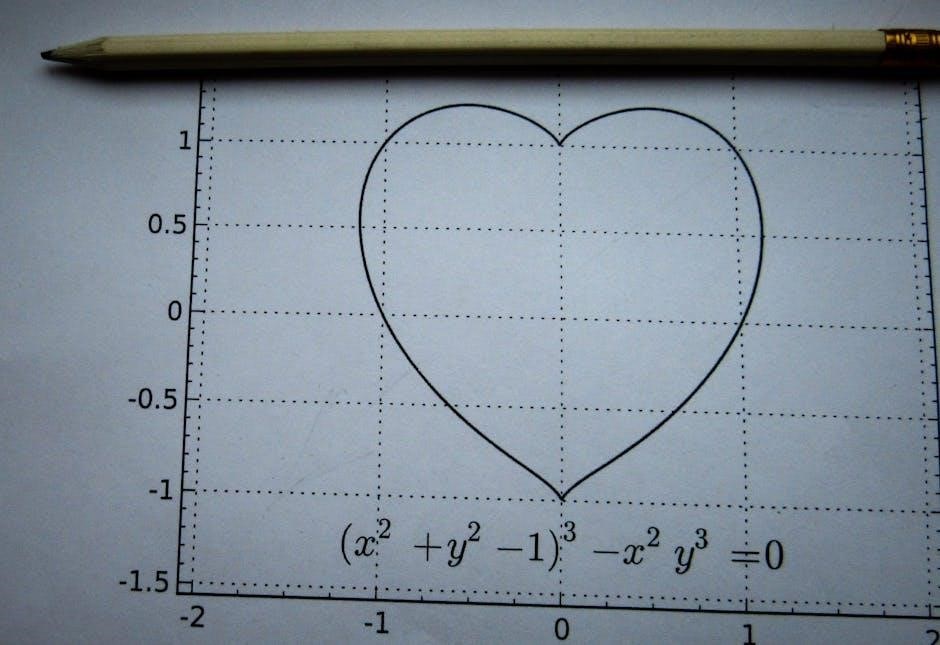
Linear Differential Equations of Order n
Higher-order equations utilize methods like undetermined coefficients and variation of parameters, building on linear algebra foundations for solving complex systems, as detailed in chapter six.
Homogeneous Equations with Constant Coefficients
These equations form a cornerstone of linear differential equation theory, often solved by assuming exponential solutions and deriving a characteristic equation. This equation, a polynomial in a derivative operator, directly leverages concepts from linear algebra – specifically, finding eigenvalues to determine solution forms.
The roots of the characteristic equation dictate the behavior of the solutions, leading to cases of distinct real roots, repeated roots, or complex conjugate roots, each requiring a specific approach. Understanding these solutions is crucial for modeling various physical phenomena, and the textbook resources provide detailed examples.
Method of Undetermined Coefficients
This technique provides a systematic approach to finding particular solutions for non-homogeneous linear differential equations with specific forcing functions – polynomials, exponentials, sines, and cosines. It involves ‘guessing’ a solution form based on the forcing function, then determining the unknown coefficients by substituting the guess into the differential equation.
The method’s success hinges on avoiding overlap with the homogeneous solution, requiring modifications to the initial guess if necessary. This process, detailed in available resources, effectively combines algebraic manipulation with differential equation principles.
Variation of Parameters
This powerful method extends the applicability of finding particular solutions to non-homogeneous linear differential equations, even when the method of undetermined coefficients fails. It leverages the fundamental solutions of the associated homogeneous equation, constructing a particular solution by varying constants within a linear combination.
The process involves solving a system of linear equations, often utilizing techniques from linear algebra, to determine the varying functions. This approach provides a general solution applicable to a wider range of forcing functions.

Systems of Differential Equations
Matrices elegantly represent interconnected differential equations, enabling solution techniques using eigenvalues and eigenvectors. This approach is crucial for modeling complex, interacting phenomena.
Matrix Representation of Systems
Transforming systems of differential equations into matrix form streamlines the solution process. This representation, A⃗x = ⃗b, allows us to apply powerful linear algebra tools. Understanding whether the system is homogeneous (⃗b = ⃗0) or non-homogeneous is vital.
Graphical interpretation reveals that solutions represent intersections – lines in a plane, or planes in 3D space. This matrix approach is fundamental for analyzing coupled systems frequently encountered in engineering and scientific modeling, offering a concise and efficient method for analysis.
Eigenvalues and Eigenvectors in System Solutions
Eigenvalues and eigenvectors are crucial for deciphering the long-term behavior of linear systems of differential equations. They reveal the system’s inherent modes of oscillation or decay.
Calculating these values allows for the decoupling of the system, simplifying the solution process significantly. The resulting solutions are expressed as linear combinations of exponential functions, determined by the eigenvalues, providing insight into system stability and response characteristics – essential for engineering applications.
The Laplace Transform
The Laplace transform simplifies solving linear differential equations, converting them into algebraic problems, and offering a powerful tool for analyzing system behavior and applications.
Definition and Properties
The Laplace transform is defined as the integral of a function multiplied by e-st, transforming functions of time into functions of a complex variable ‘s’.
Key properties include linearity, allowing the transform of sums to be the sum of transforms.
Differentiation in the time domain becomes multiplication by ‘s’ in the Laplace domain,
and integration becomes division by ‘s’. These properties significantly simplify the process of solving differential equations,
converting them into algebraic manipulations, and then applying the inverse Laplace transform to obtain the solution.
Applications to Differential Equations
The Laplace transform excels at solving linear differential equations with constant coefficients, particularly initial value problems. By transforming the differential equation into an algebraic equation,
solving for the transformed variable becomes straightforward.
The inverse Laplace transform then yields the solution in the time domain. This method is particularly effective for systems involving electrical networks,
economic models, and even analyzing the behavior of Markov chains, offering a powerful analytical tool.
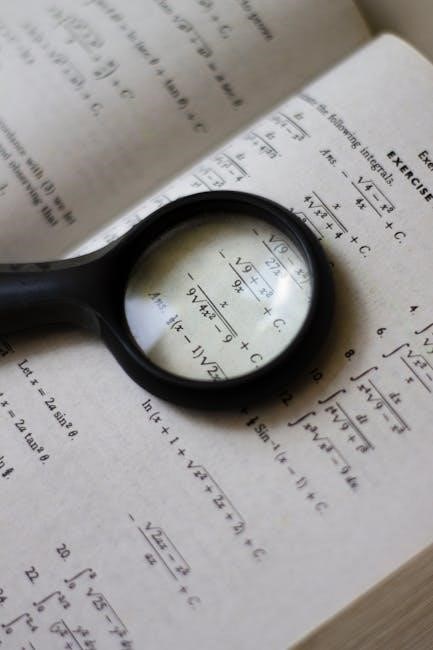
Series Solutions
Power series methods provide solutions when elementary techniques fail, exploring special functions crucial for modeling complex phenomena. These techniques are detailed in Chapter 9.
Power Series Methods
Employing infinite series to represent solutions is vital when standard approaches prove inadequate. This technique, particularly useful for linear differential equations, involves expressing the unknown function as a power series. The coefficients are then determined by substituting the series into the differential equation and solving for them iteratively.
This method’s success hinges on the equation’s coefficients and the initial conditions. Convergence of the resulting series must also be carefully examined to ensure a valid solution; Chapter 9 delves into these methods, offering a comprehensive exploration of their application and limitations.
Special Functions and Their Solutions
Certain differential equations yield solutions that are so frequently encountered they’ve earned dedicated names and extensive study. These “special functions,” like Bessel functions, Legendre polynomials, and others, arise in diverse physical applications. Understanding their properties and behaviors is crucial for modeling real-world phenomena.
Chapter 9 expands on these, detailing their derivation and characteristics. These functions often serve as building blocks for more complex solutions, offering a powerful toolkit for tackling challenging problems in engineering and science.

Applications in Engineering and Science
These mathematical tools are vital for modeling diverse systems, including electrical networks, economic models, and Markov chains,
demonstrating their broad applicability across scientific and engineering disciplines.
Electrical Networks
Differential equations and linear algebra are fundamental to analyzing electrical circuits. Kirchhoff’s laws establish systems of equations describing voltage and current relationships. These systems, often represented in matrix form, are solved using techniques from linear algebra, like Gaussian elimination.
Furthermore, the behavior of circuits over time – charging/discharging capacitors or inductor currents – is modeled by differential equations. Laplace transforms, a key concept, simplify solving these equations, providing insights into circuit stability and frequency response. Understanding these connections is crucial for electrical engineering applications.
Economic Models
Differential equations and linear algebra provide powerful tools for modeling dynamic economic systems. Input-output models, utilizing matrices, analyze interdependencies between industries and determine production levels needed to meet demand.
Growth models, such as those describing population or capital accumulation, are often expressed as differential equations. Linear algebra aids in analyzing stability and predicting long-term economic trends. These mathematical frameworks allow economists to simulate scenarios and inform policy decisions effectively.
Markov Chains
Markov Chains, a fundamental concept in probability and statistics, heavily rely on linear algebra for analysis. Transition matrices, representing probabilities of moving between states, are central to these models.
Eigenvalues and eigenvectors reveal long-term behavior and steady-state distributions. Differential equations can model continuous-time Markov chains, describing the rate of change in state probabilities. Applications span diverse fields, including finance, queuing theory, and genetics, demonstrating the power of this combined mathematical approach.
Homogeneous Systems
Homogeneous systems, where the constant term is zero, are crucial for understanding solution spaces and intersections of planes,
representing graphical solutions as intersections.
Understanding Homogeneous Equations
Homogeneous equations, characterized by a zero constant vector (b = 0), represent a fundamental aspect of both linear algebra and differential equations. These systems always possess at least one trivial solution – the zero vector.
Analyzing these equations reveals the inherent structure of the solution space, often involving infinitely many solutions dependent on free variables.
Graphical interpretations, particularly in two or three dimensions, demonstrate solutions as intersections of planes or lines passing through the origin, providing a visual understanding of their properties.
Solutions and Intersection of Planes
Solutions to systems of linear equations geometrically represent the intersection of planes. In three dimensions, these intersections can range from a single point to a line, or even an entire plane if the equations are dependent.
A system with no solutions indicates the planes do not intersect, while infinite solutions signify overlapping or coincident planes.
Understanding this spatial relationship is crucial for visualizing and interpreting the behavior of solutions within the context of both linear algebra and differential equations.

Linear Algebra Arithmetic
Fundamental operations and properties of linear algebra are essential, providing the tools to solve systems of equations and analyze matrices – key for problem-solving.
Basic Operations and Properties
Linear algebra arithmetic encompasses scalar multiplication, matrix addition, and matrix multiplication, forming the bedrock for solving systems arising in differential equations. Understanding vector space properties – associativity, commutativity, and distributivity – is crucial. These operations enable manipulation of equations and facilitate finding solutions.
Homogeneous systems, where the constant term is zero, are particularly important, representing intersections of planes. The properties dictate how solutions behave and interact, impacting the overall solution space. Mastering these fundamentals unlocks advanced techniques.
Applications to Problem Solving
Linear algebra and differential equations find extensive applications in diverse fields. Electrical networks utilize these tools to analyze circuits, while economic models leverage them for forecasting and stability analysis. Markov chains, probabilistic models, rely heavily on matrix representations and solution techniques.
Furthermore, these concepts are vital in understanding systems of differential equations, representing interconnected phenomena. The combined approach equips engineers and scientists with powerful methods for modeling and solving real-world problems effectively.
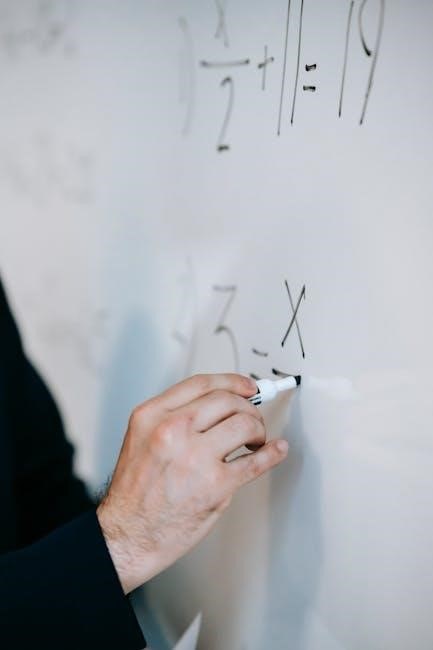
Combined Course Structure
This integrated course, requested by the Engineering School, merges linear algebra and differential equations into a cohesive, half-semester format for efficient learning.
Integration of Linear Algebra and Differential Equations
The synergy between linear algebra and differential equations is paramount, as systems of differential equations are elegantly represented and solved using matrix methods. Linear algebra provides the tools to analyze the behavior of solutions, particularly through eigenvalues and eigenvectors.
This combined approach allows for a deeper understanding of both subjects, revealing how concepts like vector spaces and linear transformations underpin the solution techniques for differential equations.
Furthermore, applications in fields like electrical networks and economic modeling benefit significantly from this integrated perspective, showcasing the practical relevance of both disciplines.
Engineering School Requirements
Many engineering curricula now necessitate a unified course encompassing both differential equations and linear algebra, recognizing their intertwined importance in modeling and analyzing complex systems. This reflects a shift towards a more holistic mathematical foundation for future engineers.
The integration streamlines learning, providing students with immediately applicable skills for tackling real-world problems.
Specifically, understanding matrix representation of systems and series solutions becomes crucial, aligning with the demands of various engineering disciplines and preparing students for advanced coursework.
Textbook Resources
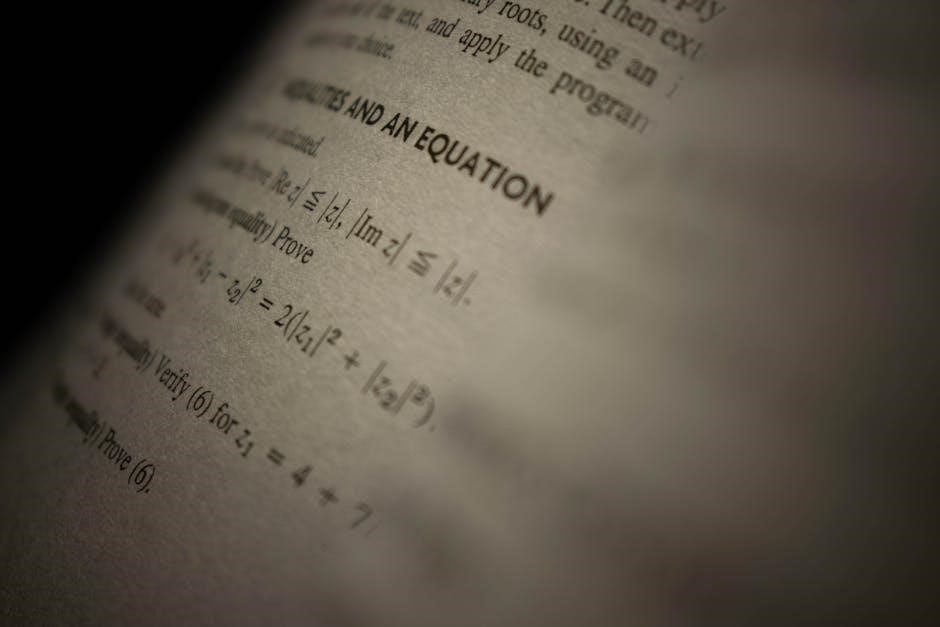
Numerous texts and open-edition resources are available, including a third edition with a comprehensive table of contents covering matrices, determinants, and series solutions.
Recommended Texts and Editions
Selecting appropriate resources is crucial for mastering this interconnected field. A frequently cited text, “Differential Equations and Linear Algebra,” Third Edition, New International Edition (ISBN 978-1292025131), provides a detailed exploration of core concepts. This edition systematically covers first-order equations, linear systems, determinants, vector spaces, and advanced topics like Laplace transforms and series solutions;
Furthermore, exploring supplemental materials and utilizing online resources can enhance understanding. Consider accessing open-edition textbooks for alternative perspectives and practice problems, complementing the primary text for a well-rounded learning experience.
Open Edition Resources
Accessible learning is paramount, and numerous open-edition resources supplement traditional textbooks. “Linear Algebra with Applications” offers a comprehensive base text, extending its reach into diverse fields like engineering, economics, and the natural sciences. These resources often include optional application sections, showcasing practical uses of concepts like electrical networks and Markov chains.
Additionally, freely available lecture notes, such as those for MATH 2350, combine linear algebra and differential equations into a unified course, reflecting the integrated approach increasingly adopted by engineering schools.
Leave a Reply
You must be logged in to post a comment.